
Pallium: The Observational AI Platform for Business

Pallium gives leadership a current operational feedback loop that is grounded in how people actually work and communicate. It replaces static measurement with continuous, contextual awareness – bridging the gap between what’s said, what’s done, and what’s needed to move forward. With Pallium, what’s hidden becomes visible – and what’s visible becomes actionable.
The Pallium Solution
Pallium is Observational AITM, an LLM-powered, evidence-backed knowledge graph that transforms your data into a strategic mirror of your organization. Pallium makes companies observable so leaders see what’s happening, not just what’s reported.
Where others track outcomes, Pallium reveals the conditions behind them – trust, alignment, friction, and flow – long before results appear in reports. It continuously ingests organizational communications (e.g., calls, chats, emails, documents) and maps them to a structured ontology of Goals, Initiatives, Issues, and ActionItems. This produces a living model of how your organization operates, what’s blocking progress, and where strategic drift may be occurring.
Insights are not only surfaced, they are traceable. Every real concern, sentiment shift, or execution gap is linked to its raw source via an “EVIDENCED_BY” relationship, creating a transparent, auditable, and actionable system of organizational awareness. Emergent issues, which are missed by static dashboards, are captured and surfaced.
Pallium redefines how companies track performance, culture, and alignment by replacing lagging indicators (like surveys and static dashboards) with passively updated evidence-grounded insights. It goes beyond traditional analytics by combining the interpretive power of LLMs with strict structural enforcement, ensuring accuracy, consistency, and interpretability. Insights can be written back to your existing tech stack including CRM, HRIS, project, and governance systems. The result is a platform that supports decision-making with clarity, speed, and confidence across departments, organizational layers, and time.
Key Problems Solved
- Manual surveys are incomplete, costly, and time-intensive
Organizations rely on delayed, self-reported data that fails to reflect reality because it is based on inferences not actual events. - AI output is often biased, generic, or fabricated
Most AI-generated insights rely on external data or generalized models, introducing bias, irrelevance, or fabrication. Pallium avoids this by working exclusively within a company’s own data set, anchoring every insight in first-party evidence. This closed-loop design ensures that outputs are specific, accurate, and traceable. - Communication insights are siloed
Valuable information remains hidden in team tools, with no unified structure to extract or connect meaning across conversations or events. - Entity duplication and drift reduce signal clarity
Similar goals or issues are referenced inconsistently across teams, making it difficult to track ownership or status. - Resulting conclusions are often inactionable due to unreliability
Insights drawn from noisy or unverified inputs lack credibility, discouraging decisive action and eroding trust in reporting.
Why Pallium Matters
Pallium gives leadership a current operational feedback loop that is grounded in how people actually work and communicate. It replaces static measurement with continuous, contextual awareness – bridging the gap between what’s said, what’s done, and what’s needed to move forward. With Pallium, what’s hidden becomes visible – and what’s visible becomes actionable.
Problem Landscape
Despite advancements in enterprise reporting, most organizations still struggle to understand their internal dynamics in real time. Leadership teams depend on delayed reporting, hand-picked anecdotes, and intermittent survey data to assess operational health and alignment. The gap between what’s happening in day-to-day work and what leadership sees in reports is wide – and growing.
- Siloed Communication and Hidden Context
The majority of business-critical insights live inside conversations: calls, emails, meeting notes, and collaborative documents. These are fragmented across systems and teams, leaving context locked in silos. Even when communication is available, it’s unstructured, inconsistently interpreted, and rarely connected back to operational strategy.
- Reactive, Not Proactive
By the time disengagement, misalignment, or risk shows up in a survey or dashboard, the damage is already done. Organizations are forced to respond to symptoms instead of root causes – reacting instead of anticipating. Static data can’t reflect the fluid, evolving nature of modern teams and customer relationships.
- Data Without Structure
Raw communication and activity logs are plentiful, but they lack the structure needed for strategic analysis. Entities like goals, issues, and initiatives are referenced inconsistently, if at all. Without resolution and normalization, meaningful patterns are hard to detect and harder to act on.
- Eroding Trust in Insights
Even when analytics dashboards are available, users are increasingly skeptical. Where did this number come from? Why is this initiative marked red? Without traceability to real conversations and decisions, insight becomes suspect – and leaders delay action for fear of acting on noise.
This is the landscape Pallium was built to navigate. It bridges the visibility gap between raw communication and strategic clarity – bringing structure, evidence, and trust to the center of how organizations understand themselves.
Competitive Differentiation
Pallium, by design, represents a fundamentally different approach to generating insights from unstructured operational data. It is not just a variation on typical business intelligence or communication analysis tools, its differentiators are rooted in a novel combination of architecture, ontology, traceability, and explainability. Pallium observes and reports, making visible the mission-critical factors that determine success.
Purpose-Built Knowledge Graph Ontology
Unlike generic graph systems or LLM-enhanced dashboards, this system defines a structured and strategic ontology around Goals, Initiatives, Issues, and ActionItems. These core entities mirror how organizations actually operate, enabling insight generation that aligns with real-world strategic execution.
Evidence-Based Insight Generation
Every insight surfaced by the system is traceable back to raw communication content through an “EVIDENCED_BY” relationship. This creates an audit trail of sentiment, decisions, and blockers, allowing teams to verify and act on insights with confidence. This level of explainability is missing in legacy LLM or analytics platforms.
Structured Entity Extraction with LLMs
The system employs constrained language models using server-enforced schemas (e.g., Pydantic) to extract not only entities, but also associated metadata like confidence scores, sentiment, and verbatim snippets. This provides reliable inputs to the knowledge graph and minimizes fabrication (hallucination) risk.
Hybrid Entity Resolution with Verification
Entity deduplication is handled through a two-stage hybrid process: Pallium combines pattern matching with deeper AI-based verification. This ensures that records referring to the same person, project, or customer are accurately unified, with each decision supported by reasoning and confidence scores.
Real-Time, Role-Specific Insights
Insights are not buried in static reports. Stakeholders can query the knowledge graph to identify concerns relevant to their function – be it operations, sales, people management, compliance, or executive leadership. The system is a living mirror of how the organization communicates and operates.
Compliance and Trust by Design
The system supports organizational trust by enforcing traceability and interpretability in every insight. Its architecture ensures that every surfaced risk or decision point can be tied back to a known source. This supports internal compliance goals (e.g., auditability, explainability, fairness) and, in future releases, external regulatory frameworks such as SOC 2, GDPR, or HIPAA.
In combination, these differentiators establish a new standard for internal visibility and organizational awareness, particularly for firms seeking to move beyond selective reporting, survey data, intuition-driven decision making, or fragmented tooling.
Architecture Of Observability
Competitive Differentiation
CEOs rarely suffer from a lack of reports or dashboards. The real challenge is that those reports lag behind reality, often masking the very issues that matter most. By the time a problem reaches the executive suite, it is frequently too late to course-correct without disruption.
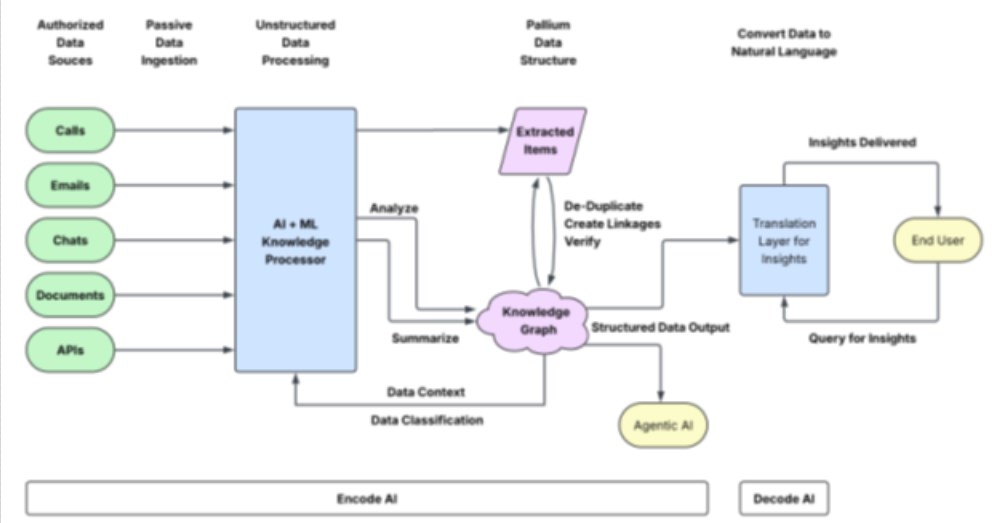
Pallium addresses this challenge by ingesting both unstructured communications (emails, chats, calls, and documents) and structured system data (from CRMs, HRIS platforms, project management tools, and more, if authorized). This dual approach captures the full spectrum of organizational activity without requiring additional reporting from employees.
Once ingested, Pallium applies a structured flow:
- Contextualizing inputs based on people, timing, and relevance to organizational goals.
- Summarizing to reduce noise while retaining critical signals.
- Extracting entities and relationships into a knowledge graph of goals, initiatives, issues, and actions.
- Verifying insights by linking them back to the original evidence, ensuring traceability.
- Storing the results in a continuously updated knowledge graph that reflects the true state of the organization.
- Making that truth available through queries in structured or plain language, depending on the audience.
For leadership, the value lies in clarity. Pallium surfaces the gap between where the company intends to be and where it actually stands, supported by evidence that can be trusted. This empowers leaders to act sooner, with more confidence, and with alignment across the executive team and the board.
Structuring Data: Bringing Order to Chaos
Pallium is an Encoder AI, a system built to understand and structure company data into a usable internal model. This allows it to capture, organize, and reveal what is actually happening inside a business. It does not invent narratives or fabricate findings. Instead, it ingests real communications and documents, mapping them into a knowledge graph of goals, blockers, and actions, with every insight traceable back to its source.
Pallium is built with a light encoder–decoder layer that translates structured truth into actionable language for executives, board members, and teams. This essential translation layer makes the underlying operational and strategic realities clear and usable. Where conventional dashboards remain static, Pallium’s dynamic mapping allows it to generate observability across an organization and to identify emergent issues so leaders see what is happening, not just what is reported.
Knowledge Graph Layer
At the center of Pallium’s architecture is an advanced knowledge graph. This graph transforms raw communications into a structured network of goals, initiatives, blockers, and actions, each linked back to the specific evidence that supports it. Unlike traditional data storage or reporting, the knowledge graph is dynamic and continuously updated as new information flows through the system.
Pallium’s approach draws directly from bioinformatics, where knowledge graphs have revolutionized the study of complex biological systems. Just as biomedical graphs connect genes, pathways, and phenotypes with evidence from research, Pallium connects organizational elements with evidence from communications and documents. This design treats a company as a living system, where insight comes not from isolated datapoints but from the patterns and relationships that shape outcomes.
By encoding relationships, temporal context, and dependencies, Pallium’s knowledge graph makes organizational dynamics observable. It is the structural backbone for leadership insights today and the input layer for emerging technologies such as advanced agentic AI tomorrow. The knowledge graph is not an optional feature but Pallium’s defining capability: the layer where understanding is organized, truth is made traceable, and observability becomes actionable.
Knowledge Graph Ontology
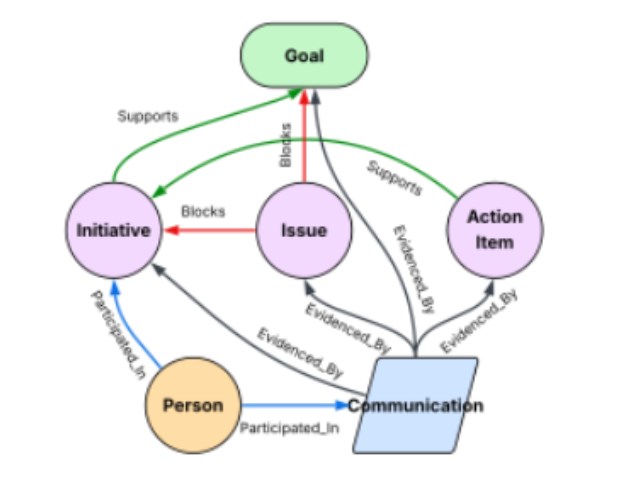
The knowledge graph works because of an ontology that defines how organizational reality is represented. This ontology provides the consistent structure that makes insights both machine-usable and human-traceable. By organizing raw signals into a graph of nodes and relationships, Pallium creates a living model of how work actually happens inside a company.
Core Nodes
- Goal: The outcomes an organization intends to achieve.
- Initiative: Programs or projects undertaken to reach those goals.
- Issue: Blockers, risks, or obstacles that threaten progress.
- Action Item: Specific tasks or steps taken to advance initiatives or resolve issues.
- Person: Individuals participating in the system, whether as leaders, team members, or customers.
- Communication: The raw source material, including emails, calls, chats, and documents, from which Pallium derives truth.
Core Relationships
- SUPPORTS: Connects initiatives to goals, or actions to initiatives, showing how work contributes to outcomes.
- BLOCKS: Links issues to the goals or initiatives they obstruct.
- EVIDENCED_BY: Anchors insights to specific communications, ensuring traceability and auditability.
- PARTICIPATED_IN: Connects people to the initiatives, actions, or communications in which they are involved.
This ontology makes hidden relationships observable, which then makes them actionable. Goals and initiatives reveal where to decide. People and participation expose where alignment exists or breaks down. Issues and actions highlight where intervention is needed. Every relationship is grounded in evidence, creating a traceable system of record that reflects not what is reported, but what is happening.
In practice, this means Pallium does not produce outdated dashboards or speculative predictions. It generates an evidence-backed graph of reality, continuously updated as new signals are captured. This knowledge graph is the structural foundation of observability: the layer where truth is encoded, traced, and prepared for translation into language leaders can act on.
Technology Stack
Underlying Pallium’s ability to deliver observability is a full technology stack designed for reliability, security, and explainability. It spans four key layers:
1. Interface and integration
- Application layer: The interface where users interact through queries and responses.
- Integration and tooling: Connects applications to foundation models, retrieving information, filtering responses, saving inputs and outputs, and enabling new features.
2. Models and learning approaches
- Foundation models: Deep learning models trained on large volumes of unstructured data, adaptable to a wide range of tasks.
- Large language models (LLMs): Human-centric models trained with self-supervised ML to process text at scale.
- Machine learning (ML) and natural-language processing (NLP): Methods that analyze and generate text and speech, scoring language for context, syntax, and signals.
- Reasoning models: Purpose-built for multistep reasoning, inference, and problem-solving beyond pattern recognition.
- Deep reinforcement learning: Neural networks trained with trial and error to make predictions using only the closed dataset provided by the user, eliminating hallucinations and bias.
- Retrieval-augmented generation (RAG): Incorporates new information into domain-specific LLMs with rules tied to Pallium’s internal data.
3. Infrastructure
- Physical infrastructure: Hardware for computation, storage, and networking, all deployed within the user’s domain to protect data.
- Digital infrastructure: Databases and core services (compute, storage, networking) abstracted from hardware to scale efficiently.
4. Trust and transparency
- Explainable AI: Tools that increase transparency by making inputs, weightings, and reasoning visible, allowing every insight to be traced back to its source.
Application to Agentic AI
Pallium is more than a platform for organizational observability. The structured data it produces prior to the translation layer can serve as an input layer for agentic AI systems. Unlike traditional dashboards or CRMs, Pallium encodes real company activity in a knowledge graph of goals, blockers, initiatives, and actions, each grounded in evidence from communications and documents.
This machine-readable structure provides agentic AI with a verified model of organizational reality. Agents can use it to perceive the state of the business, identify dependencies, monitor emerging issues, and recommend or initiate next steps. Instead of working from incomplete reports or synthetic assumptions, agentic AI can act on a continuously updated and traceable foundation.
By grounding autonomous decision-making in evidence-backed data, Pallium reduces the risks of fabrication and misalignment that limit many AI systems today. In this way, Pallium is not only a tool for leaders and teams, but also a potential operating substrate for next-generation agentic AI.
Application to Process Automation
While Pallium’s primary role is to deliver observability, the same evidence-backed insights can also drive action. Once gaps or blockers are identified, Pallium can be adapted to trigger process automation. This includes updating records in a CRM, adjusting tasks in a project management system, or prompting customer service representatives with real-time guidance to reduce escalations. By linking observability directly to operational workflows, Pallium not only shows what is happening, but also helps organizations act faster and more consistently on the reality it reveals.
Roadmap for the Future
Pallium’s architecture is designed not only to deliver observability today, but also to expand into more advanced capabilities over time. Upcoming developments include:
- Cross-organization graph analytics to enable industry benchmarks and comparative insights across companies.
- Automated prioritization of action items so leaders and teams can focus on the interventions that will have the greatest impact.
- Team-level performance patterns to surface systemic strengths and weaknesses across functions and departments.
- Individualized training recommendations tailored to employees based on observed communication patterns, blockers, and contributions.
Together, these roadmap initiatives extend Pallium’s role from observability into foresight, helping organizations not only see what is happening, but also anticipate what to do next.
Intellectual Property & Technical Innovations
Foundational Innovations
Pallium is built on proven technologies such as knowledge graphs, language models, and explainable AI. What sets it apart are the foundational innovations that make these technologies reliable, precise, and usable in the enterprise.
1. Structured LLM Extraction with Server-Enforced Schema
Most AI systems extract information in free-form ways that are inconsistent and difficult to audit. Pallium enforces schema at the server level, ensuring that all data is captured in a structured, reliable, and repeatable format. This provides executives and boards with confidence that insights can be trusted and traced.
2. Hybrid Entity Resolution
Organizations generate overlapping names, records, and references across communications and systems. Pallium resolves these with high precision by combining vector similarity, LLM reasoning, and justification steps. The result is accurate de-duplication without false matches, protecting the integrity of insights across the enterprise.
3. Graph-Centric Insight Model
Unlike dashboards or static databases, Pallium’s knowledge graph is the query surface itself. This enables leaders to surface hidden blockers, execution gaps, and unresolved issues that traditional systems overlook. By treating the graph as the core engine, Pallium provides a dynamic and continuously updated map of organizational health.
4. Evidence Traceability
Every insight generated by Pallium is anchored to evidence. Communications, documents, or records that underpin a finding are linked directly, and enriched with sentiment and confidence scoring. This eliminates the risk of hallucinated results and ensures that decisions are grounded in verifiable truth.
Together, these innovations define Pallium’s contribution to enterprise AI. They ensure that the system does not just process data, but delivers truth that is structured, precise, and traceable — the kind of foundation required for leadership decisions that shape the future of a company.
Intellectual Property
Pallium’s architecture is protected under a provisional patent application titled “Knowledge Graph for Processing Events and Providing Insights Regarding a Work Environment.” This patent, filed in July 2025, covers the system’s ability to ingest multimodal organizational data – including communications, documents, and application records – and structure it into a dynamic knowledge graph of goals, initiatives, issues, and action items.
Central to the claim is Pallium’s method of linking every insight back to source communications through evidence-backed relationships. This ensures that organizational truth is not only observable but also verifiable. By formalizing this approach in its intellectual property, Pallium establishes a defensible technical foundation that differentiates it from conventional AI tools, dashboards, or reporting systems.
Pallium is the first Observational AI platform to be offered commercially. The company has filed for trademark protection for the terms “Observational AI” and “Observational Artificial Intelligence.”
From Insight To Action
Pallium was created with a simple mission: to make companies observable – so leaders see what’s happening, not just what’s reported. By combining structured extraction, hybrid entity resolution, a graph-centric model, and evidence traceability, Pallium delivers observability at a level that existing dashboards and reports cannot.
As organizations face increasing complexity, the ability to see reality as it unfolds is no longer optional – it is foundational to execution, trust, and resilience. Pallium provides this capability today, while building toward a future of cross-organization analytics, automated prioritization, and individualized training.
We invite you to take the next step – whether through a pilot installation, a strategic partnership, or a technical deep dive. Pallium is ready to show how observability transforms leadership: revealing what’s happening, before it’s too late.
Appendix 1: Example Use Cases for Organizational Insight via Knowledge Graphs
This section illustrates how the system described in our provisional patent can transform raw communication data into actionable insights across various organizational domains.
Sales Team Performance and Pipeline Confidence
Problem: Sales leadership lacks reliable insight into opportunity health. Pipeline reviews depend on manual CRM updates and anecdotal summaries. Early signs of deal risk—such as stakeholder disengagement or misalignment—go unnoticed until it’s too late.
Outcome: The system ingests sales calls, emails, and internal communications, tagging them to Initiatives and surfacing Issues. It identifies sentiment drop-offs and missing engagement from key decision-makers in at-risk accounts.
Result: Sales leadership intervenes early, reassigns executive sponsors, and salvages a $180K opportunity. Team-wide sentiment analysis reveals a training gap, leading to improved rep coaching. Time-to-resolution for at-risk deals improves by 26% over 90 days.
Customer Service Quality and Escalation Prevention
Problem: Escalations and churn often stem from issues hidden in call transcripts or chat logs. CSAT is delayed and QA sampling is limited. Patterns of poor experience go undetected.
Outcome: The system analyzes transcripts and tags Issues across accounts. It detects repeat frustrations linked to recent product changes. A rep is flagged for missing soft escalation cues.
Result: A KB article and internal comms protocol are updated. Escalation volume drops 42% within a week. First-call resolution improves by 18%. Targeted coaching leads to sentiment recovery and a 7-point increase in NPS.
Talent Management and Cultural Health Monitoring
Problem: HR lacks early indicators of disengagement or attrition risk. Surveys are subjective and infrequent. Performance feedback is inconsistent and manually documented.
Outcome: The system surfaces sentiment and Issue trends from day-to-day communication. It detects morale drift and rising attrition risk in a high-performing team.
Result: Mentorship and mobility programs are introduced. Attrition in the affected team drops 40%. Systemic insights inform company-wide manager training. Leadership gains a real-time cultural health view.
Client Success and Relationship Risk Detection
Problem: Health scores and QBR decks miss early signs of dissatisfaction. Key client concerns are buried in threads or undocumented.
Outcome: The system identifies subtle sentiment drops and unaddressed Issues tied to unmet roadmap expectations. It links poor engagement to missed follow-ups from internal teams.
Result: CSMs escalate early, renewals are preserved, and account expansion follows. Tier 1 churn drops 22%. Client success gains a real-time view of risk and support quality across the portfolio.
Internal Operations and Process Optimization
Problem: Operational friction (e.g., handoff gaps, unclear ownership) is discovered too late. Process reviews depend on anecdotal input and manual tracking.
Outcome: The system links repeated Issues across Legal, Procurement, and IT to a single unresolved ActionItem. Each department assumed another was handling it.
Result: A process owner is assigned and onboarding delays drop 35%. Escalations disappear. Operations moves from reactive cleanup to proactive coordination, informed by traceable insight trails.
Executive Alignment and Strategic Drift Detection
Problem: Executives lack ground-level insight into whether initiatives are being executed. Misalignment builds slowly and manifests too late for correction.
Outcome: The system shows that a strategic goal is under-referenced and unsupported by active Initiatives or ActionItems. Related Issues are unassigned and unresolved.
Result: Leadership reframes the goal and assigns clear ownership. Within one quarter, tooling costs drop 18% and hiring decisions accelerate. Executives gain a living dashboard of strategic traction.
Governance, Risk, and Compliance (GRC) Monitoring
Problem: Policy violations and risk exposures are often discovered only during audits or retrospectives. Compliance lacks ongoing, evidence-based visibility into process adherence.
Outcome: The system flags repeated compliance gaps in sales proposals and vendor onboarding workflows. These gaps are linked to specific departments and tracked as unaddressed Issues.
Result: Templates and processes are updated. A major enterprise audit passes without findings. Compliance becomes proactive, with risk exposures traceable to communication patterns. Internal control maturity is raised.


